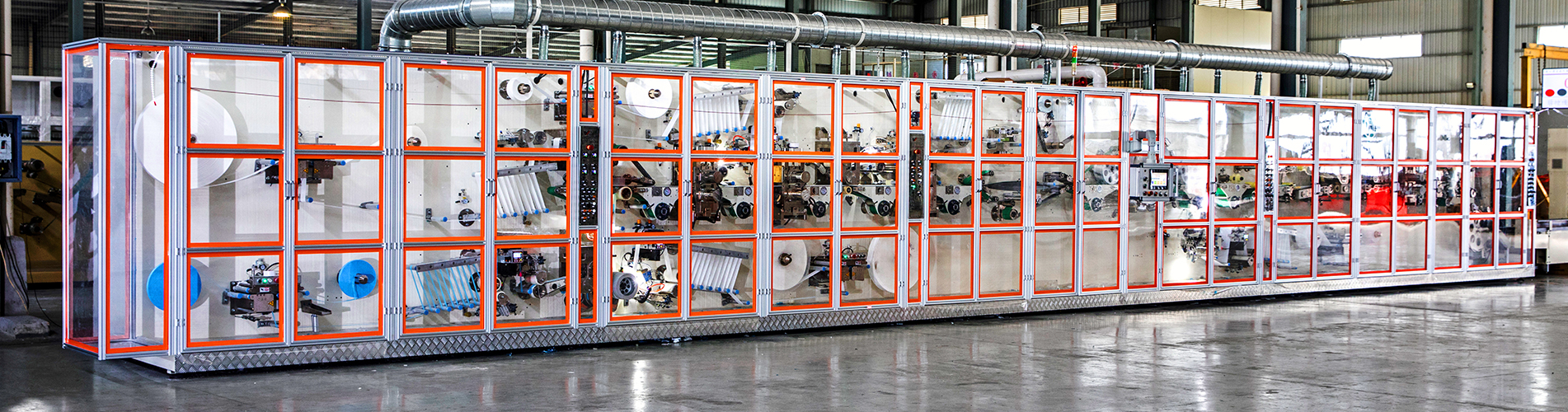
5 Critical Mistakes to Avoid When Choosing Your First Diaper Production Line
Starting your own disposable diaper brand is a highly profitable venture, driven by the steady global demand for baby care and adult incontinence products. However, setting up a diaper manufacturing plant is a capital-intensive project.
For startup entrepreneurs with little technical background, choosing the wrong machinery is the fastest way to drain your budget.
Based on our decades of experience helping global brands build factories from scratch, here are the 5 critical mistakes you must avoid when purchasing your first diaper production line.
Mistake 1: Overpaying for "Excessive Capacity" You Don't Need
Many startups fall into the trap of buying high-speed mega-machines (producing 800+ pcs/min) thinking "bigger is better."
-
The Reality: High-speed lines are incredibly expensive, highly sensitive to raw material quality, and require top-tier technicians to debug. As a new brand, your initial sales volume won't justify running a 1,000 pcs/min machine. It will sit idle, wasting your cash flow.
-
The Smart Choice: Start with a stable, mid-speed diaper making machine (around 300 to 500 pcs/min for baby diapers). It offers a much lower initial investment, a shorter payback period, and higher fault tolerance for training your local workers.
Mistake 2: Ignoring the 10+ Raw Material Supply Chain
A diaper looks simple, but it is a complex engineering product made of over 10 different raw materials—including non-woven fabrics, Super Absorbent Polymer (SAP), fluff pulp, frontal tapes, elastic ribbons, and hot-melt glue.
-
The Reality: A machine without materials is just a piece of useless iron. Many entrepreneurs buy a machine only to realize they cannot source the correct specifications of SAP or non-woven fabric locally, or they cannot meet the huge Minimum Order Quantities (MOQs) of global raw material giants.
-
The Smart Choice: Partner with a machinery supplier that provides a Turn-key Solution. Your supplier should not only sell the machine but also bundle and supply calibrated raw materials for your first 3 to 6 months of production.
Mistake 3: Forgetting About Local Voltage and Compliance Standards
Industrial machinery is not "plug-and-play."
-
The Reality: Standard machinery in Asia typically runs on 380V/50Hz. However, if your factory is in the United States, your local industrial power grid requires three-phase 460V or 480V at 60Hz. Ordering a machine without matching local electrical codes means it will either burn out or require a massive, expensive transformer. Furthermore, in regions like the US or EU, your components might need UL or CE certifications to pass local safety inspections.
-
The Smart Choice: Always inform your manufacturer about your target factory location during the consultation phase so they can customize the motors, PLC systems, and safety guards to meet local regulations.
Mistake 4: Relying on "Manual Packing" for High-Speed Lines
To save money, some startups buy a fast production line but choose manual labor for the final packaging step to avoid buying an automatic packing machine.
-
The Reality: A mid-speed line drops 300 to 400 diapers per minute into the stacking gate. No matter how fast your workers are, human hands cannot keep up with that speed. This creates a severe bottleneck at the end of the line, forcing you to slow down the entire machine, which ruins your production efficiency.
-
The Smart Choice: Balance your budget by investing in at least a semi-automatic packing machine or a modular line that allows you to upgrade to a fully automatic packaging system as your brand grows.
Mistake 5: Underestimating the Technical Learning Curve (Who Will Run It?)
A diaper production line is a high-precision system. The tension control of the non-woven fabrics, the cutter alignment, and the glue temperature all require precise adjustments.
-
The Reality: If you think you can just press a button and walk away, your factory will face constant downtime and high waste rates. Finding a local specialized diaper engineer (called a "Machine Captain") in Western countries can be difficult and extremely expensive.
-
The Smart Choice: Ensure your machinery contract includes On-site Engineering Support. Your manufacturer must send overseas technicians to your factory to install the line, test the local materials, and provide a 1-to-2-month intensive training program for your local staff.
? Looking for a Risk-Free Way to Start Your Diaper Factory?
Avoiding these mistakes is easy when you have the right partner. At
DNW Machine, we specialize in helping startup entrepreneurs worldwide transition from "zero" to fully operational diaper plants.
We don't just export industrial machinery. We provide a comprehensive Turn-key Project Solution, including:
-
Customized 300-500 pcs/min startup lines built with global compliance (UL/CE/US Voltage).
-
Complete factory layout and workshop 3D designs.
-
One-stop sourcing and bundling for all diaper raw materials.
-
Global dispatch of engineers for on-site installation and staff training.